“Where sapphire waters, stone-terraced hillsides, and a civilisation woven together by thread converge above the roof of the world.”
High above the deep blue expanse of Lake Titicaca, where the horizon feels almost infinite and the air carries a crystalline stillness, lies Taquile Island. Reached only by boat, this small Andean island appears at first like a quiet scattering of stone houses and agricultural terraces. Yet what unfolds here is not defined by landscape alone. It is defined by hands.
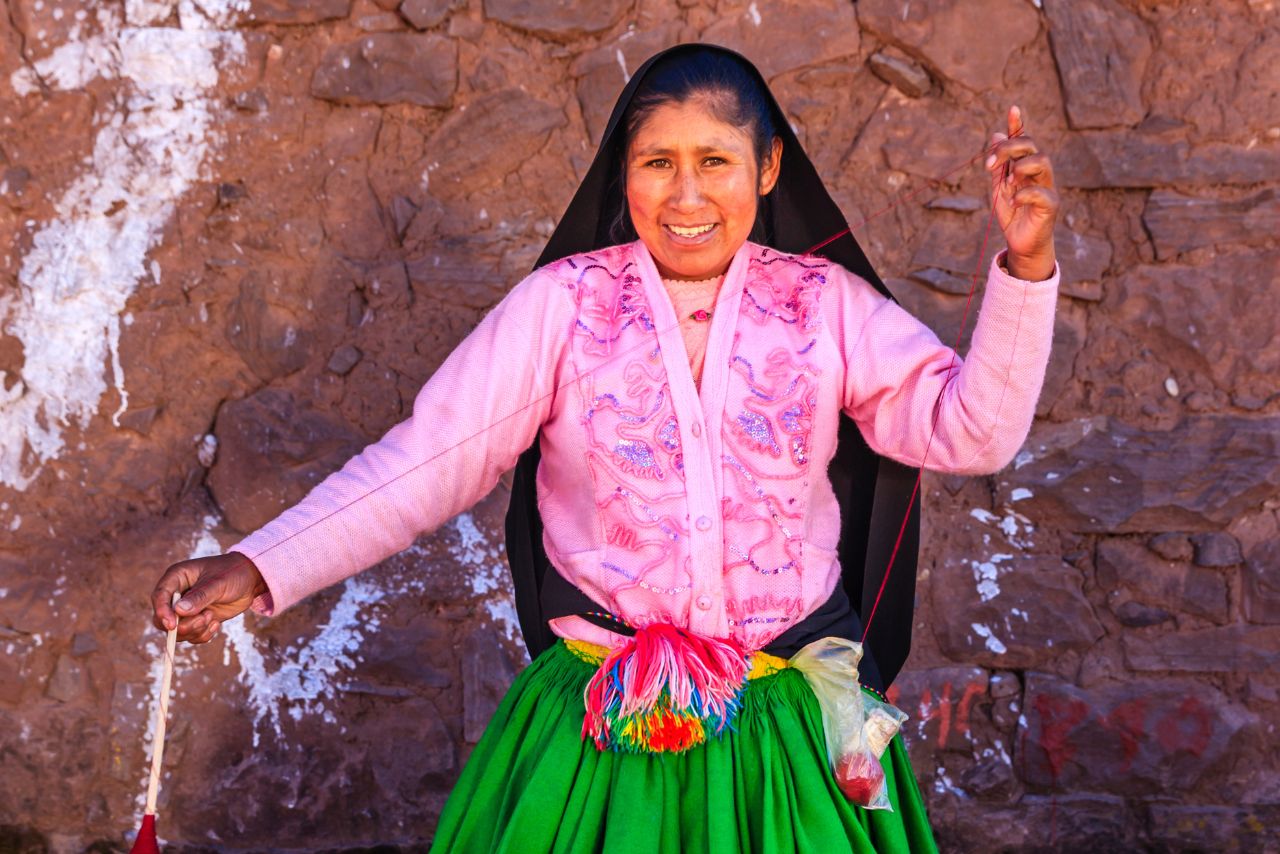
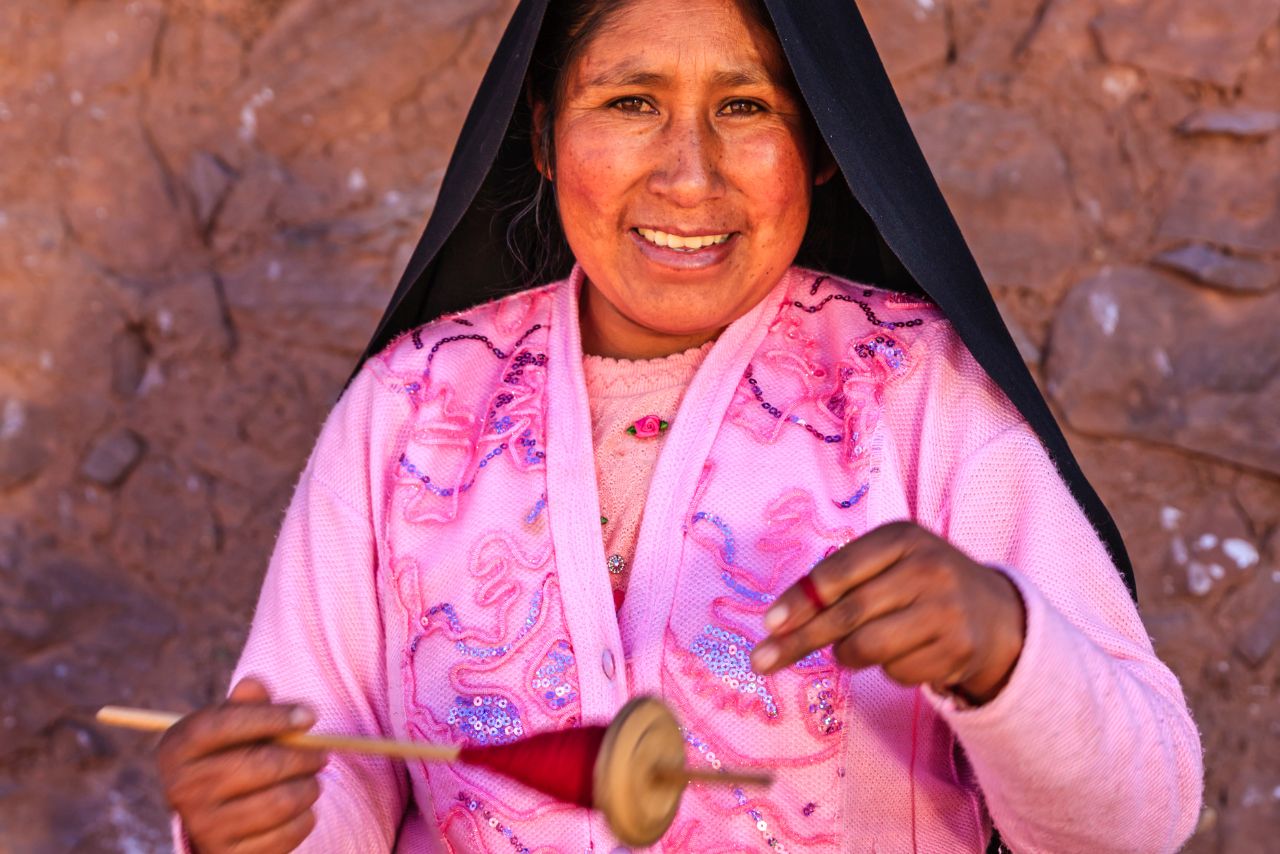
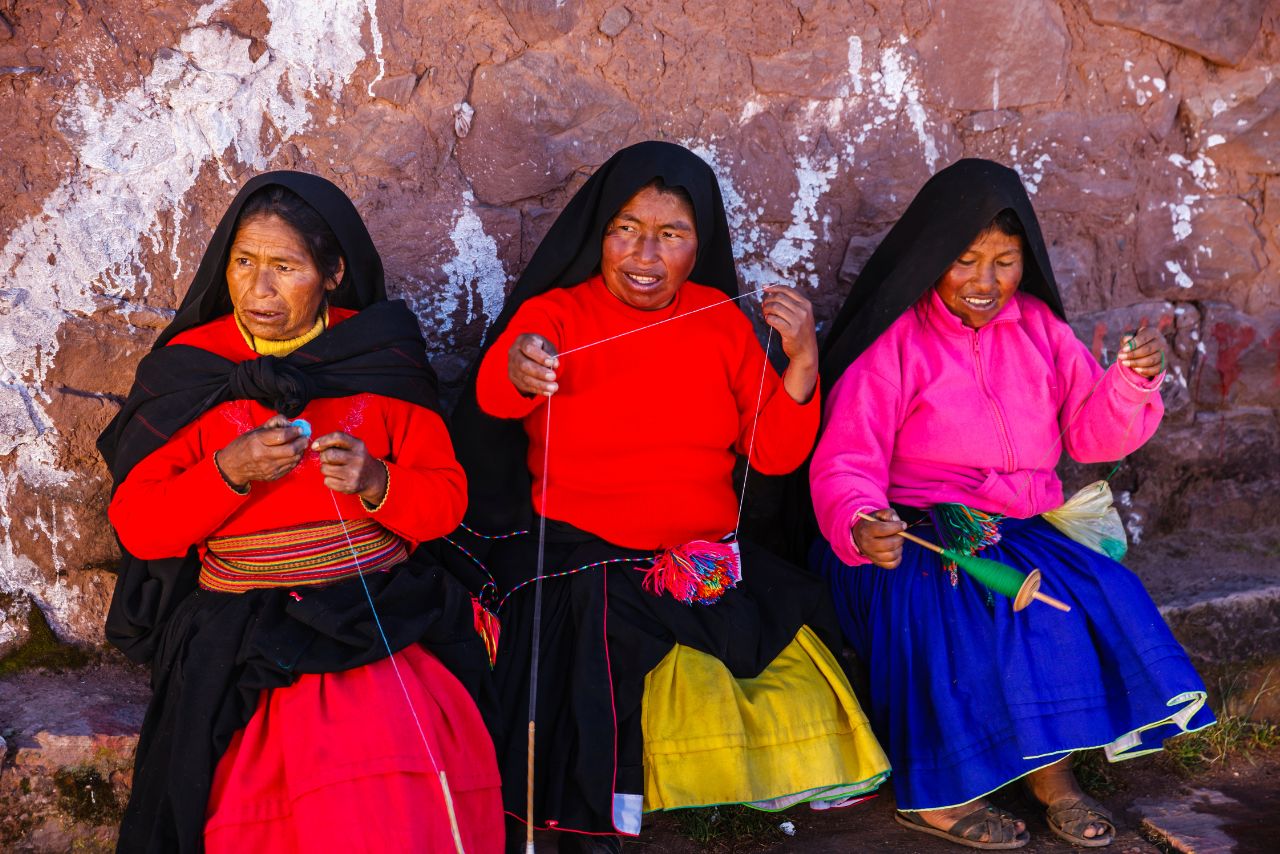
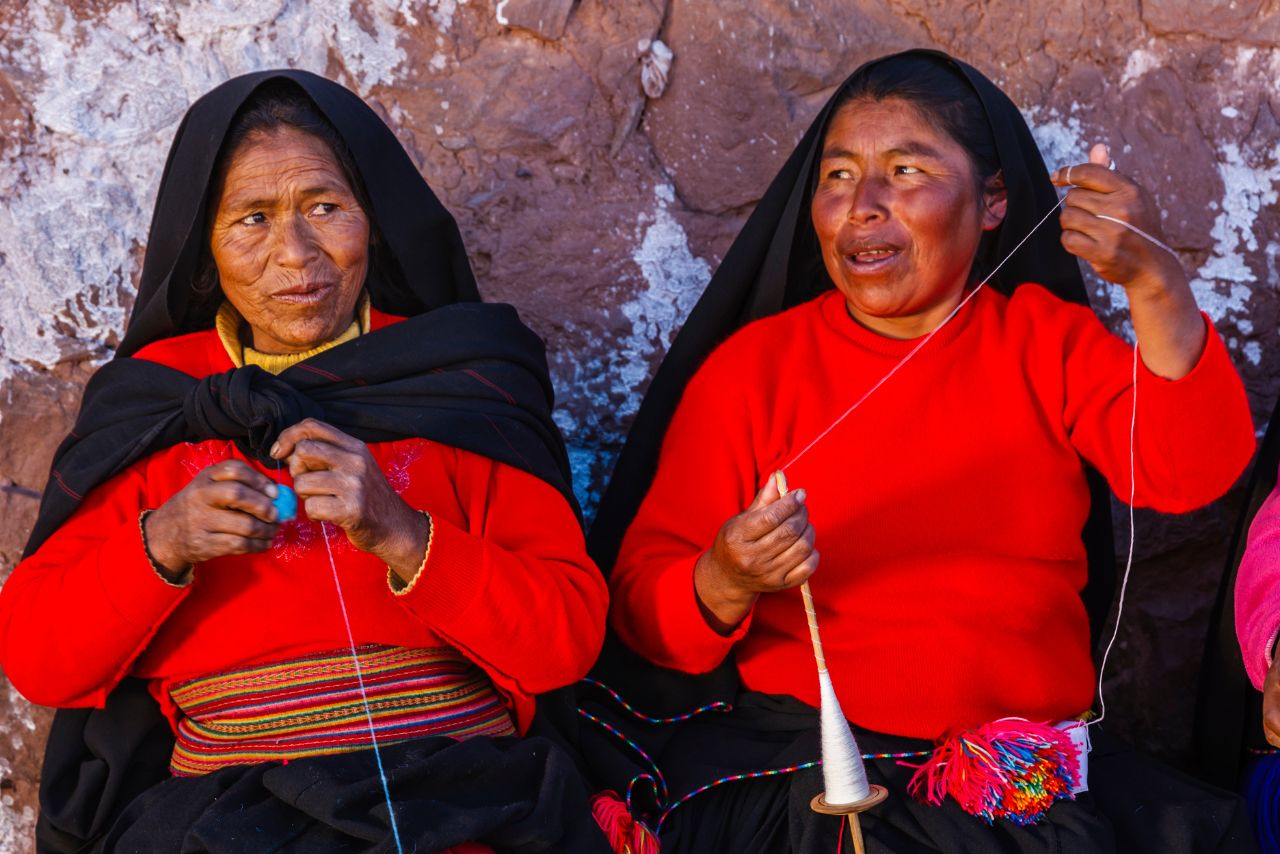
On Taquile, spinning is not a performance, nor a craft separated from the cadence of daily life. It is an act as constant and unassuming as breathing. Wool is drawn, twisted, and released into thread while walking along stone paths, while tending fields, and while seated beneath the wide Andean sky. The movement is steady and unhurried. It carries no flourish, no theatrical pause. It simply continues, as it has for generations.
The First Thread: Where It All Begins
Before weaving, before color, before pattern, there is thread.
Spinning on Taquile begins with wool from sheep raised on the island or from alpacas sourced across the highlands. The wool is washed, carded, and prepared with meticulous care. The spindle, small and balanced, becomes an extension of the hand. With practiced ease, wool fibers are drawn out and twisted into fine, even strands. The gesture is fluid, economical, and precise.
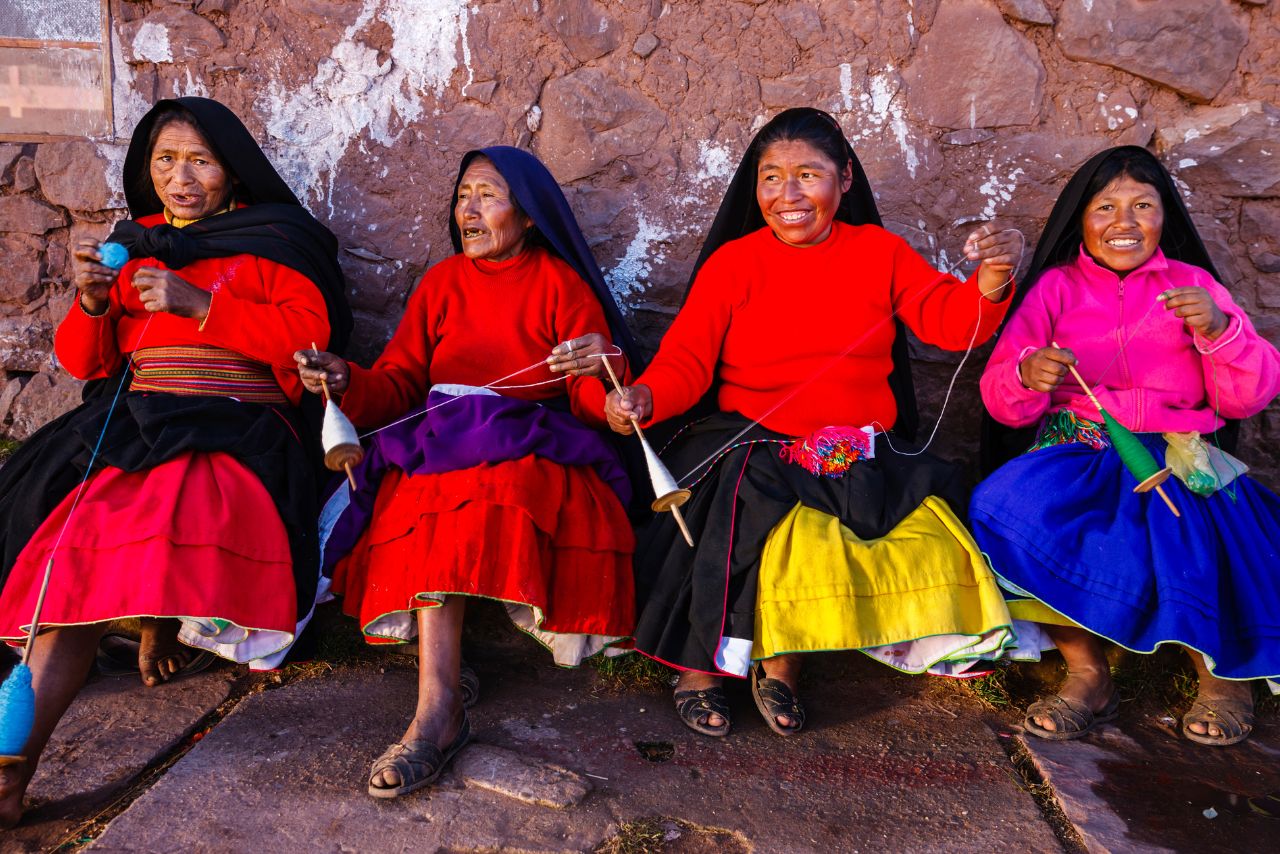
What distinguishes the spinning of Taquile is not only its technical excellence, but its integration into life. A woman may spin while walking up steep terraces. A man may spin while pausing to speak with a neighbor. The spindle turns as naturally as conversation unfolds.
There is no workshop hidden away from view. The entire island is the atelier.
A Living Language of Color
On Taquile, color is never arbitrary.
Dyes are chosen with intention, traditionally derived from natural sources, such as plants, roots, and minerals that yield deep reds, earthy browns, luminous yellows, and quiet blues. Each hue carries resonance. Each shade is considered within the larger harmony of a finished textile.
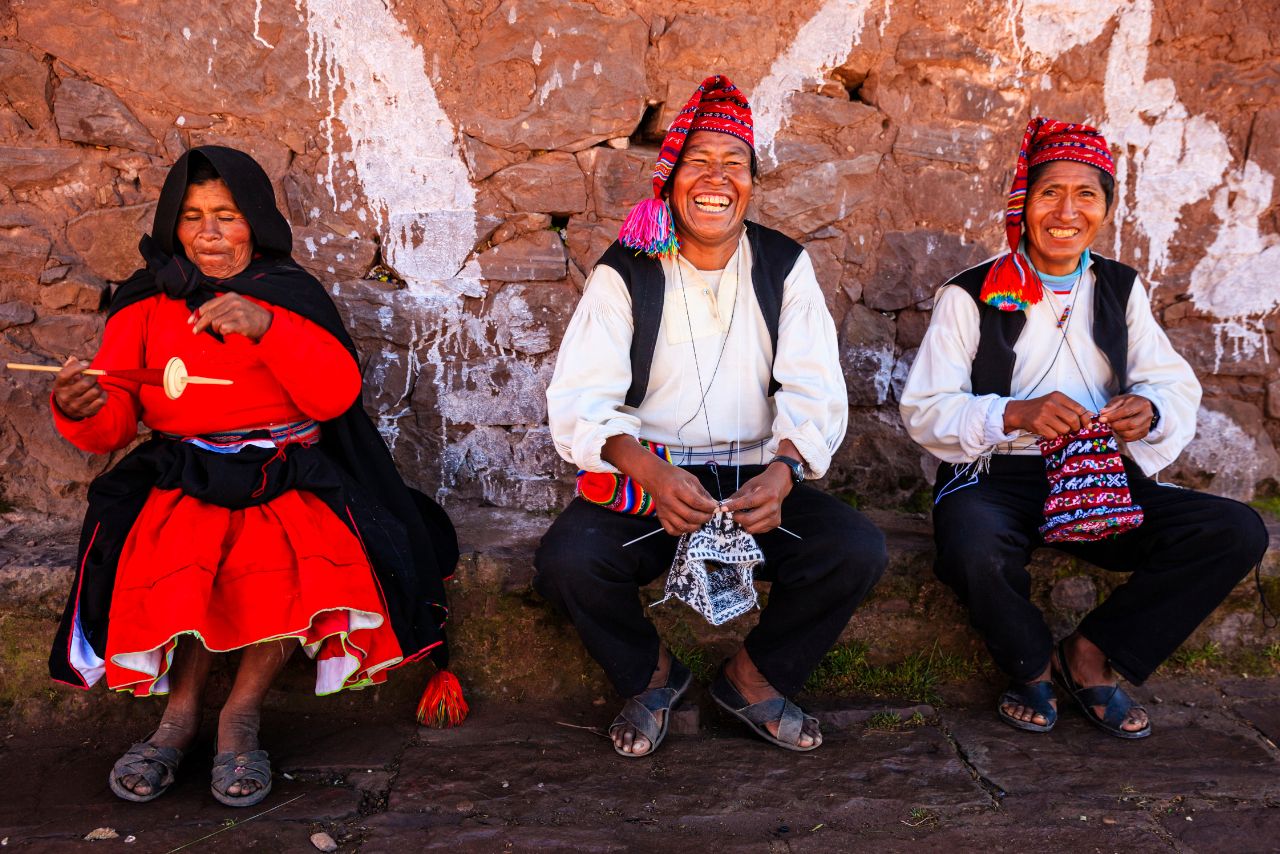
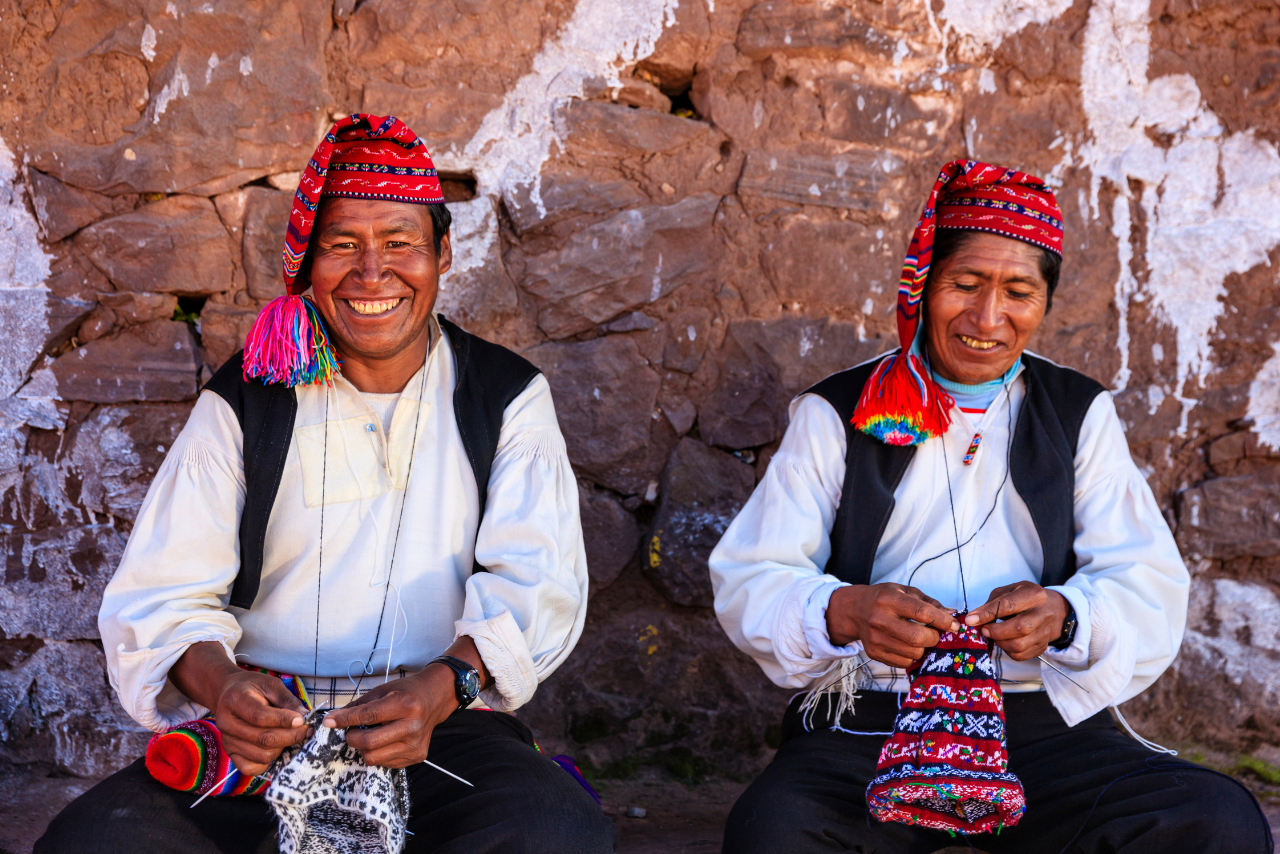
Patterns too speak, though never loudly. They reveal marital status, community belonging, and subtle aspects of identity. In particular, the finely knitted chullo, the iconic Andean hat, serves as a visible marker of life stage and social role. The intricacy of its design reflects patience, skill, and dedication.
Yet these meanings are not announced or explained. They are understood within the community, passed from one generation to the next through observation rather than instruction.
Children grow up watching hands at work. They learn not through formal lessons but through presence, by sitting nearby, by imitating gestures, by absorbing rhythm.
One of Taquile’s most remarkable distinctions lies in its distribution of roles. Unlike many textile traditions across the Andes, on Taquile it is men who knit.
From a young age, boys learn to knit their own chullos with extraordinary precision. The first hat a young man produces is closely examined; its quality speaks to his discipline and attention. Women, meanwhile, are renowned for their spinning, transforming raw wool into thread of exceptional fineness and strength.
This shared responsibility forms a quiet balance within the community. Spinning and knitting are not tasks divided by hierarchy but by heritage. Together, they create the textiles that have become synonymous with Taquile’s identity.
The island’s textile art has been recognized globally for its authenticity and continuity, yet here it remains grounded. There are no grand declarations of cultural preservation. There is simply continuity, which is daily and deliberate.
The act of spinning on Taquile cannot be separated from its setting.
At over 3,800 meters above sea level, the light is sharp and luminous. Lake Titicaca stretches vast and reflective, its waters shifting between cobalt and silver. Terraces carved into hillsides trace lines of agricultural memory. Stone pathways wind upward toward the island’s modest central square.
Within this environment, spinning becomes part of the scenery. The movement of the spindle mirrors the circular rhythm of lake and sky. The drawing of wool into thread echoes the terraced lines across the hills.
It is as though the island itself participates in the act.
Visitors who arrive expecting a demonstration soon realize they are not witnessing something staged. There is no spectacle. Instead, there is intimacy. A woman seated on a low stone wall continues her spinning uninterrupted. A child passes by carrying bundles of wool. A man adjusts his knitted cap before greeting a neighbor.
Time feels elongated here. Not slowed artificially, but recalibrated.
Spinning Beneath the Andean Sky
In many parts of the world, traditional crafts are revived, curated, or reconstructed. On Taquile, they were never abandoned.
The art of spinning survives not because it has been preserved for tourism, but because it remains essential. Textiles are worn daily. They are exchanged, gifted, and integrated into community life. They are not museum pieces.
This continuity lends a particular authenticity to the experience of observing the process. There is no separation between the artisan and the individual. The spinner is also a mother, a farmer, a neighbor. The craft is inseparable from identity.
The result is something profoundly moving. Not because it is dramatic, but because it is steady.
An Encounter with Living Heritage
Taquile’s textiles have been celebrated internationally, yet the island resists transformation into spectacle. There are no aggressive markets or theatrical presentations. Instead, visitors are welcomed into a living environment where art remains inseparable from routine.
To witness spinning on Taquile is to encounter heritage in its most organic form. It is not archived or curated. It is practiced.
And in that practice lies resilience.
In a world increasingly defined by speed and replication, Taquile offers something rare: continuity without compromise. Creation without urgency. Identity expressed not through proclamation but through pattern and thread.
An Invitation to Experience It for Yourself
The art of spinning on Taquile Island is not defined by grandeur. It is defined by quiet devotion.
Thread emerges from wool, pattern emerges from thread, and identity emerges from pattern. Each stage unfolds with care. Each movement carries memory.
Going to Taquile is not the same as going to a demonstration. It is to get into a rhythm. To sit, watch, and take in. To see that culture can exist peacefully, without performance.
High above Lake Titicaca, beneath expansive skies and along ancient stone paths, spinning continues.
And for those who pause long enough to witness it, the experience lingers long after the boat has carried them back across the water.
Plan Your Trip
Getting there: Fly into Juliaca International Airport from Lima or Cusco (approximately one hour), then transfer by road to Puno, a journey of roughly 45 minutes. From Puno’s port, public collective boats depart for Taquile most mornings, with a journey time of approximately two-and-a-half to three hours; faster tourist boats complete the crossing in around ninety minutes. The island levies a modest entrance fee, payable on arrival, which feeds directly into the community fund. Overnight homestays are available through the island’s own cooperative accommodation network and are warmly recommended: the experience of watching the stars above Titicaca from 4,000 metres, before waking to the sound of drop spindles at dawn, is not easily forgotten.
Seasons: The dry season (May to October) brings clear skies and ideal hiking conditions; August in particular coincides with community textile fairs when new work is unveiled. The wet season (November to April) brings dramatic storms across the lake but also a lush, green island and considerably fewer visitors.
Book through: For a fully curated, community-conscious Taquile experience, including arranged weaving workshops, private guided ridge walks, and bespoke textile consultations with island artisans, contact our travel designers at Enigma.
All itineraries are designed in direct partnership with Taquile’s community council, ensuring that every aspect of the visit benefits the island equitably and on its terms.